
What the Kailasa Temple is, how it was carved from a single rock, how Ellora is laid out, when to visit and how to combine it with Ajanta, with practical tips for planning the day.
Reviewed by Mirza Shadab Beg, Founder, Travelage India, Agra · Last updated 28 October 2026 · 14 min read
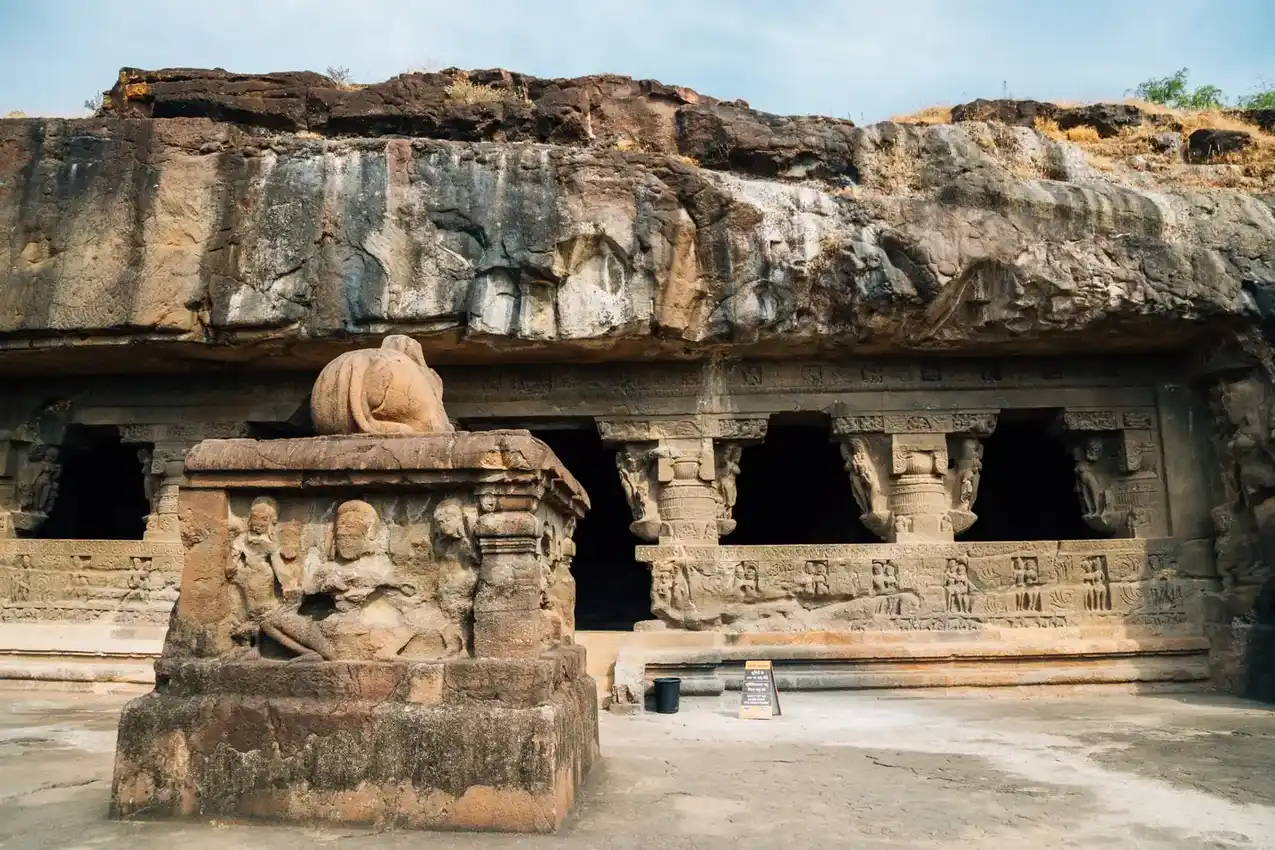
the Kailasa Temple (Cave 16 at Ellora) is a vast Shiva temple carved from one rock in the 8th century, under the Rashtrakuta dynasty. Ellora is about 30 km from Aurangabad and is normally closed on Tuesdays. Allow half a day for Ellora, and a separate day for Ajanta, which is normally closed on Mondays.
The Kailasa Temple is a Hindu temple dedicated to Shiva, and it is Cave 16 in the Ellora complex in Maharashtra. It is called a cave only because it sits in the same basalt cliff as the others. In reality it looks like a freestanding temple, with a gateway, a pillared hall, a sanctum and a tall tower, yet every part of it was cut out of living rock rather than built from blocks. It is the largest single monument at Ellora, and for many travellers it is the reason to make the journey.
The name comes from Mount Kailash in the Himalaya, the mythical home of Shiva. The whole design is a way of bringing that mountain to the Deccan plateau, and the idea is easiest to feel when you stand in the courtyard and look up at the temple rising above you. Visitors who have only seen photographs often assume it was assembled piece by piece. It was not. Everything you see was removed from the rock, which is why guides describe it as sculpture on the scale of architecture.
Ellora as a whole is a UNESCO World Heritage Centre listing and its monuments are protected by the Archaeological Survey of India. That protection explains the rules you will meet on site, from the closing day to the limits on touching carvings. This guide explains what you will see, how long to allow, when to go and how Ellora fits with Ajanta, the second great cave site in the region.
The temple dates to the 8th century and belongs to the period of the Rashtrakuta dynasty, which ruled much of the Deccan at the time. The king Krishna I is usually credited with commissioning it, and the work probably continued under later rulers, as projects of this size often did. Dates and attributions are discussed by historians, so you will sometimes hear slightly different versions from different guides. All agree on the dynasty and the century.
What makes the temple remarkable is the method. The carvers worked from the top down. They began at the crest of the hillside, cut a deep trench around a huge block of basalt, and then shaped the roof first, then the walls and pillars, and finally the base. There was no scaffolding to climb and no way to correct a mistake once the rock was gone. The courtyard around the temple is the trench they left behind, and the galleries along its edges were cut into the cliff at the same time.
Scholars often point to temples further south, such as those at Pattadakal, as an influence on the design, which suggests that craftsmen or ideas travelled widely. These are three details that explain why the Kailasa Temple is treated as a landmark of world architecture:
Plan to enter through the gateway and pause in the courtyard before you begin looking at details. The scale takes a few minutes to absorb, and the courtyard is where the temple shows itself best. A guide will usually lead you in a loop, so you see the main parts in a sensible order.
Ellora has 34 caves along a basalt cliff of about two kilometres. They were made over several centuries by communities of three faiths, which is part of the site’s appeal. The Buddhist caves are generally the earliest, the Hindu caves came next and the Jain caves are the latest. The numbering runs from south to north, so Kailasa, at Cave 16, sits in the middle of the Hindu group.
| Group | Caves | Why they are worth seeing |
|---|---|---|
| Buddhist | 1 to 12 | Monasteries and prayer halls, including Cave 10, the Vishvakarma cave, a hall with a carved stupa and a ribbed ceiling |
| Hindu | 13 to 29 | Cave 15 (Dashavatara), Cave 16 (Kailasa), Cave 21 (Rameshvara) with river goddess figures, and Cave 29 (Dhumar Lena) |
| Jain | 30 to 34 | Smaller, detailed caves, including Cave 32 (Indra Sabha), with fine carving on pillars and ceilings |
Seeing three faiths carved into one cliff gives the site a mood that is quite different from a single temple. Guides often tell visitors that Ellora reflects a period in which several traditions flourished close to each other. If you have time, walk between groups, not just between numbers, and notice how the style changes.
On a morning visit, many travellers see Kailasa first, while the courtyard is quiet and the light is clear. Tour buses commonly arrive later, so an early start gives you more room. After Kailasa, Cave 15, Cave 10 and Cave 32 give a good spread across the three groups.
The answer depends on how deeply you want to look. Kailasa alone can fill an hour, because there is so much to see, and the other caves each reward a stop. The table gives three common plans. These are guides to pacing, not rules, and your own energy and the heat matter as much as the clock.
| Time | What you can do | Who it suits |
|---|---|---|
| About 2 hours | Kailasa Temple and Cave 15 | Travellers short of time, or those combining Ellora with other sights on the same day |
| Half a day (about 4 hours) | Kailasa, the viewpoint, Caves 10, 15, 21 and 32 | Most first-time visitors, with time for breaks and photographs |
| A full day | The whole cliff in order, plus a stop at Daulatabad Fort or a temple nearby | Travellers who love history, architecture or photography |
If you plan to see Ajanta as well, do not try to do both in one day. Ajanta is a long drive away, and rushing either site spoils the other. A guide can also help you decide which caves to skip when you are tired, because the rock floors and steps add up over a morning.
Ellora is open most days of the week, but it is normally closed on Tuesdays. The authorities set opening hours and can change them, so confirm the closing day and the times before you go. Ajanta has a different closing day, which is explained further down. If you are travelling during a festival or public holiday, ask in advance, because the site can be very busy and some arrangements change.
| Season | What it is like | Tips |
|---|---|---|
| October to February | Dry, clear and comfortable for walking | The best period for most visitors; mornings can be cool |
| March to May | Hot, with strong sun on bare rock | Go very early, carry water and a hat, and rest at midday |
| June to September | Monsoon: green hills, seasonal waterfalls on the cliff, humid air | Floors and steps can be slippery; wear shoes with grip and expect showers |
As for time of day, early morning is best. The light is soft, the courtyard is quiet and the rock has not yet heated up. Midday is the hardest hour in the hot months. Late afternoon can also be pleasant, but you will have fewer hours to explore, so it works better as a second visit than a first.
Ellora is about 30 km from Aurangabad, which is now officially called Chhatrapati Sambhajinagar, and the drive usually takes 45 minutes to an hour, depending on traffic and stops on the way. Most travellers base themselves in Aurangabad for one or two nights and visit by road. The road passes close to Daulatabad Fort, which makes a natural stop on the same day.
| From | Usual way to reach the region | Note |
|---|---|---|
| Aurangabad | Road, about 30 km | The easiest base for Ellora and Ajanta |
| Mumbai | Flight, train or a long drive to Aurangabad | Flights and trains run on several routes; road is a long day, so most travellers do not choose it |
| Delhi | Flight to Aurangabad, direct or with a connection depending on the season | Check current routes and schedules, because airlines change them often |
Because routes and timetables change, ask us or check the current schedules when you plan. We often suggest arriving the evening before, so you can start Ellora early the next morning without a rushed transfer. More background on visiting heritage sites is on Incredible India.
Ajanta and Ellora are often mentioned together, but they are very different places. Ajanta is a horseshoe-shaped gorge with Buddhist caves known for their wall paintings. Ellora is a long cliff with rock-cut temples and monasteries known for their sculpture. Seeing both gives you two very different views of ancient Indian art, but each needs its own day.
| Ellora | Ajanta | |
|---|---|---|
| Distance from Aurangabad | About 30 km | About 105 km, around two and a half hours each way |
| Main interest | Sculpture and architecture, including Kailasa | Painted murals and carved Buddhist caves |
| Faiths | Buddhist, Hindu and Jain | Buddhist |
| Usual closing day | Tuesday | Monday |
| Time needed | Half a day or more | A full day |
Ajanta is darker inside than most visitors expect, and the paintings are fragile, so flash photography is not allowed and some caves have limited lighting or restricted access. The best plan is Ellora on one day and Ajanta on the next, with the closing days in mind. Because Ellora closes on Tuesdays and Ajanta on Mondays, an itinerary that leaves one of them for Monday or Tuesday can fail. Always check the current closing days with the authorities or your operator before you fix the order.
The area around Ellora has several places that fit neatly into the same day or the next. Not all of them will suit every traveller, so choose by interest and energy:
Ellora involves a lot of walking on stone floors, uneven paths and steps. A few simple choices make the day easier:
Mobility is worth thinking about early. The Kailasa courtyard has uneven floors and several steps, and reaching the viewpoint above takes more effort still. If you or a member of your party find stairs difficult, tell us in advance so we can plan a gentler route and the right pace. Kailasa is generally treated as a protected monument, not a place of daily worship, but respectful behaviour is expected everywhere.
A private guide turns a large, silent monument into a story. At Kailasa, a good guide explains how the carvers worked, which scenes show Shiva and which come from the epics, and where to stand for the best view. A driver handles the road from Aurangabad, waits while you explore and keeps the day flexible if you want to stay longer or skip a cave. For travellers with limited time, that flexibility often matters more than any single sight.
Our Ajanta, Ellora and Kailasa Temple tour sets out both sites with the closing days in mind. If you are building a longer route across India, see our Mumbai and Goa tour, our 14 days private India tour and our guide to the best time to visit India. First-time visitors may also like our India itinerary for first-timers.
It is a Hindu temple dedicated to Shiva, carved from a single rock at Ellora in Maharashtra, and it is Cave 16 in the Ellora complex. It was cut from the top downwards in the 8th century and is the largest monument at Ellora.
It is Cave 16 at Ellora, in the middle of the Hindu group of caves, which runs from Cave 13 to Cave 29.
It dates to the Rashtrakuta dynasty in the 8th century, and the king Krishna I is usually credited with commissioning it. Historians discuss the details, and work may have continued under later rulers.
From the top down. The carvers cut a trench around a huge block of rock, shaped the roof and upper parts first, and worked downwards to the base, so no scaffolding was needed and mistakes could not be undone.
Ellora is normally closed on Tuesdays, and Ajanta on Mondays. Opening days and hours are set by the authorities, so confirm them before you plan.
About 30 km, which is usually 45 minutes to an hour by road. Aurangabad is now officially called Chhatrapati Sambhajinagar.
A short visit to Kailasa and one or two caves takes about two hours. Most first-time visitors prefer half a day, and a full day suits those who love history or photography.
It is not recommended. Ajanta is about 105 km from Aurangabad, around two and a half hours each way, so it needs its own day. Plan Ellora on one day and Ajanta on another.
Photography is generally allowed in most areas, but rules on flash, tripods and drones can change, so check at the entrance. At Ajanta, flash is not allowed near the paintings.
Yes, with a calm pace. The floors are uneven and there are steps, so shoes with grip are important. Tell us in advance if anyone finds stairs difficult, and we will plan a gentler route.
Related journeys: Ajanta, Ellora & Kailasa Temple Tour, Mumbai & Goa Tour, 14 Days Private India Tour.

Mirza Shadab Beg began as a local tour guide in Agra and founded Travelage in 2003. He has worked as a local handling agent for BTI Sita, HRG Sita, Kuoni Travel Business, Century Travel and Gilpin Travel. Travelage is rated 4.9 on Tripadvisor from 466 reviews, is registered with the Ministry of Tourism NIDHI database (ID EUP000616), and has been recognised by Les Clefs d’Or India. Facts such as timings and rules are checked before each update, and may change.
Tell us your dates. We will plan Ajanta and Ellora around the closing days and the light.