
Most visitors give Agra one monument and one morning. That is a pity, because the city holds a vast Mughal fortress, a jewel-box tomb that inspired the Taj, a riverside garden with a famous view and a deserted red sandstone capital within an hour’s drive. This guide shows how to build a half day in Agra that goes beyond the Taj Mahal, and how to use the Friday closure to your advantage.
Reviewed by Mirza Shadab Beg, Founder, Travelage India, Agra · Last updated 28 October 2026 · 8 min read
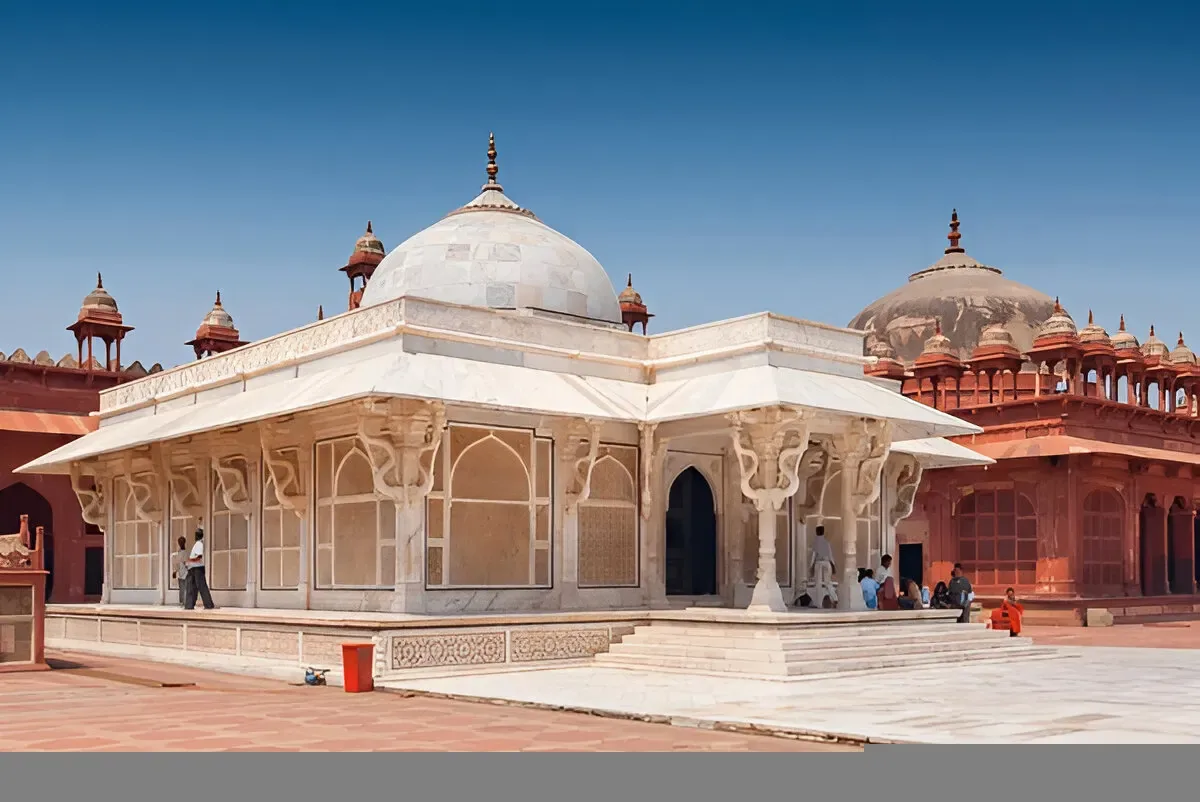
Agra Fort is a UNESCO World Heritage Site and takes about two hours with a guide. Pair it with Itimad-ud-Daulah (the “Baby Taj”) and Mehtab Bagh at sunset for a full half day. Fatehpur Sikri is about 40 km away and fits on the road to Jaipur. The Taj Mahal is closed on Fridays, but the Fort stays open.
Agra Fort stands on the west bank of the Yamuna river, about two and a half kilometres from the Taj Mahal, and it is easy to underestimate from the outside. Its walls are a deep red sandstone, and behind them lies a walled city of palaces, courtyards, audience halls and mosques that served as the heart of the Mughal empire for generations. The Mughal emperor Akbar began the red sandstone fortress in the 1560s, and his grandson Shah Jahan later rebuilt much of the interior in white marble, which is why the Fort shows two very different moods in one visit.
UNESCO lists Agra Fort as a World Heritage Site, in the same decade as the Taj Mahal, and the two monuments belong in the same story. Shah Jahan, who built the Taj, is traditionally said to have spent his last years in the Fort, looking along the river towards the tomb of his wife. Whatever the exact details of that tradition, standing on the marble terraces and seeing the Taj as a pale shape in the haze is one of the quiet highlights of a trip to Agra.
A part of the Fort is still used by the Indian army and is closed to visitors, so you will see only a portion of the complex. That portion is still large, and it rewards a guide who can explain what you are looking at.
Allow about two hours. Visitors normally enter by the Amar Singh Gate on the south side, and walk up a long, sloping ramp into the main courtyards. The route inside is not always signposted clearly, which is one of the best reasons to go with a licensed guide.
These are the parts most visitors remember:
Some rooms, such as the Sheesh Mahal, the palace of mirrors, are often closed to the public, and access can change without notice. Ask your guide what is open on the day, and do not plan your whole visit around a single room.
The table gives a rough guide to the main places that travellers combine with Agra Fort. Times are approximate and include moving around the site, not the drive between places.
| Place | Time needed | Best hour | What to expect |
|---|---|---|---|
| Agra Fort | About 2 hours | Morning, from opening | Large red sandstone fortress, marble terraces, river view of the Taj |
| Itimad-ud-Daulah (Baby Taj) | About 45 minutes | Late morning or mid afternoon | Small marble tomb with fine inlay, quiet, on the east bank |
| Mehtab Bagh | About 45 minutes | Late afternoon until sunset | Garden across the river facing the Taj Mahal |
| Sikandra (Akbar’s tomb) | About 1 hour | Morning | Red sandstone tomb in green gardens, about 13 km from the centre |
| Fatehpur Sikri | 2 to 3 hours | Morning or on the way to Jaipur | Abandoned Mughal capital, about 40 km from Agra |
Yes, and it is often the most underrated stop in Agra. Itimad-ud-Daulah is a small marble tomb on the east bank of the Yamuna, built in the early 17th century by Nur Jahan, the wife of the emperor Jahangir, for her father. Art historians often describe it as a forerunner of the Taj Mahal, because it was one of the first Mughal tombs built entirely of white marble and decorated with detailed inlay, with coloured stones set into the surface in patterns of flowers, cypress trees and wine vessels.
The tomb is small enough to see in about forty-five minutes, and it is rarely crowded, so it is a calm break between larger sites. Look closely at the inlay on the outer walls, the carved stone lattice screens and the painted ceiling inside. The garden around it is neatly laid out, and the river-facing gateway is a pleasant place to sit.
If you are short of time, Itimad-ud-Daulah is the best addition to a morning at the Fort. It is a taste of the craft behind the Taj, without the queues.
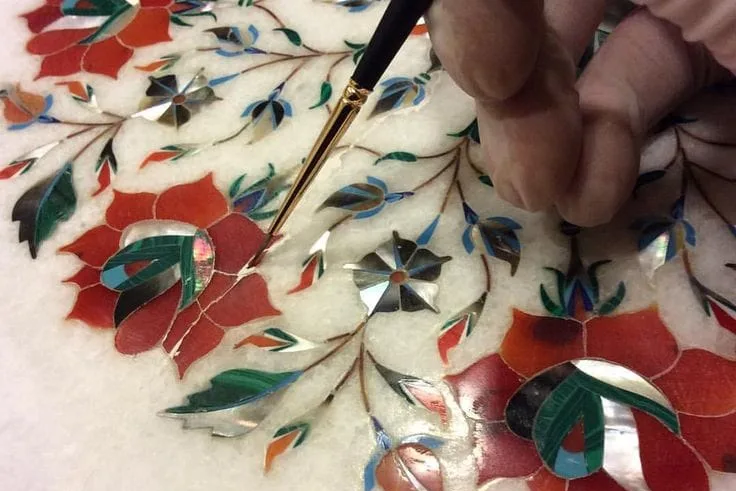
Fine stone inlay in white marble, a craft still practised in Agra.
Two places give a good view without entering the monument: the marble terraces of Agra Fort, and Mehtab Bagh. Mehtab Bagh is a garden on the opposite bank of the Yamuna, in line with the Taj Mahal, and it was laid out in the Mughal period as part of the riverside gardens of Agra. In the late afternoon the sun sets behind you and the white marble catches a warm light, and it is one of the best places for photographs.
This matters most on Fridays, when the Taj Mahal is closed. We plan Friday in Agra around the Fort, Itimad-ud-Daulah and an evening at Mehtab Bagh, so that you still see the Taj from a distance, and you have the whole of the next morning for the monument itself if your dates allow. Opening hours and access to the garden can change, so ask your guide to confirm on the day.
The order depends on the day of the week and on whether you are seeing the Taj Mahal on the same trip. These are the three plans we use most often.
In winter, mornings can be foggy, which reduces views from the Fort terraces. In those months the afternoon plan is often better. See our Sunrise Taj Mahal tour if you want to combine an early Taj visit with the Fort.
Sikandra, about 13 km from the centre of Agra, holds the tomb of Akbar, set in large gardens with a red sandstone gateway that is decorated in white marble. It takes about an hour, and is a good choice for a morning when the light is soft.
Fatehpur Sikri is about 40 km from Agra, roughly an hour by car. It was built by Akbar as his capital and then left, and today it is a beautifully preserved red sandstone city that UNESCO also lists as a World Heritage Site. It lies beside the road to Jaipur, so it fits neatly into a day on the Golden Triangle: you leave Agra after breakfast, spend two to three hours at Fatehpur Sikri, then continue to Jaipur. The distance from Agra to Jaipur is about 240 km, and with the stop the day is long but comfortable.
If you are not travelling on to Jaipur, Fatehpur Sikri is still possible as a half day out of Agra, but we would not combine it with the Fort and Itimad-ud-Daulah on the same day.
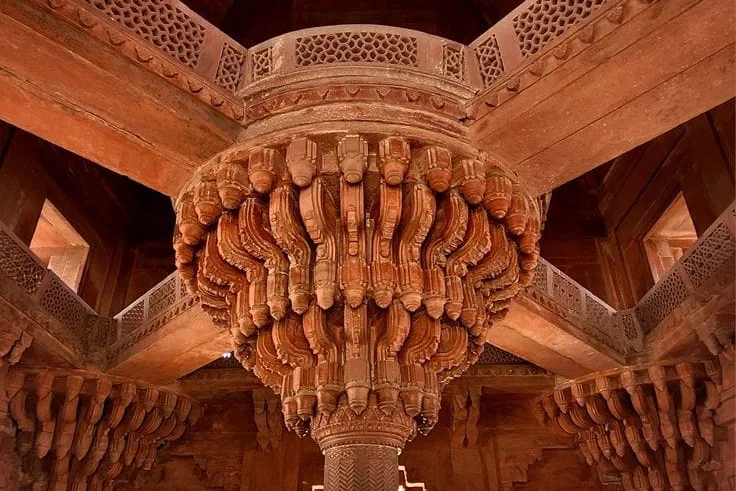
The carved central pillar of the Diwan-i-Khas at Fatehpur Sikri.
For official information on monuments and opening arrangements, see the Archaeological Survey of India website.
Agra rewards slow travel with good company. A licensed guide turns the Fort from a series of red walls into a story, and tells you which rooms are open and which are closed that day. A private driver means your car is waiting at the right gate, so you do not lose time at the end of each visit looking for transport.
It also means you can move the plan. If the morning is foggy, you swap the Fort for the afternoon. If someone tires, you shorten the day. Our team has planned journeys from Agra since 2003, and we match the plan to your dates, including the Friday closure. See our Taj Mahal and Agra tours, or read our Taj Mahal timings and tickets guide to plan the monument itself.
About two hours with a guide. Allow a little longer if you want to take photographs from the marble terraces.
Yes. The Taj Mahal is closed on Fridays, but Agra Fort is normally open every day, which makes it the best choice for a Friday morning.
It is the nickname for Itimad-ud-Daulah, a small marble tomb on the east bank of the Yamuna, built in the early 17th century and famous for its detailed inlay.
From the marble terraces of Agra Fort, and from Mehtab Bagh, the garden on the opposite bank of the river.
About 40 km, roughly an hour by car. It lies on the way to Jaipur, so it is easy to add to a day on the Golden Triangle.
Yes. The two are about two and a half kilometres apart. Most travellers see the Taj at sunrise and the Fort later in the morning, or the Fort first and the Taj in the late afternoon.
No. A part of the Fort is used by the Indian army and is closed, and some palaces and rooms are closed from time to time. Your guide will tell you what is open on the day.
Comfortable shoes with a good grip, light clothing that covers shoulders and knees, a hat and sunscreen in summer. There is a lot of walking on stone.
October to March is the most comfortable. December and January mornings can be foggy, and April to June is very hot.
Related journeys: Agra Overnight Taj Tour, Taj Mahal & Agra Tours, 2 Days Delhi Agra Tour.

Mirza Shadab Beg began as a local tour guide in Agra and founded Travelage in 2003. He has worked as a local handling agent for BTI Sita, HRG Sita, Kuoni Travel Business, Century Travel and Gilpin Travel. Travelage is rated 4.9 on Tripadvisor from 466 reviews, is registered with the Ministry of Tourism NIDHI database (ID EUP000616), and has been recognised by Les Clefs d’Or India. Facts such as timings and rules are checked before each update, and may change.
Tell us your dates. We will plan the fort, the tombs and the sunset.