
Jaipur is the easiest of Rajasthan’s great cities to visit, and the easiest to rush. It sits about 280 km from Delhi and is the natural third stop on the Golden Triangle, but it deserves more than a single afternoon. This guide shows how to plan two, three or four days in Jaipur, in the right order for the forts, the City Palace and the bazaars.
Reviewed by Mirza Shadab Beg, Founder, Travelage India, Agra · Last updated 28 October 2026 · 9 min read

two days covers Amber Fort, the City Palace, Jantar Mantar and Hawa Mahal. A third day adds Nahargarh, Jaigarh and the bazaars, and a fourth day adds a workshop or a day trip to Abhaneri or Samode. Go to Amber Fort early, to avoid the crowds and the heat.
Two full days is the practical minimum. It lets you see the headline sights without running between them: Amber Fort in the morning of the first day, the City Palace, Jantar Mantar and Hawa Mahal in the same afternoon, and a second day for the hilltop forts and the bazaars.
Three days is better, and it is the length we recommend for most travellers. The third day adds a block-printing workshop, a slower lunch and an evening in the old city. A fourth day suits travellers who like to go deeper, with a day trip to the stepwell at Abhaneri or the palace at Samode. If you are travelling on the Golden Triangle, our 5 Days Golden Triangle tour spends two nights in Jaipur.
Jaipur is about 240 km from Agra and about 280 km from Delhi, so most visitors arrive after a long drive. Add that to the plan, and do not expect a full sightseeing day on arrival.
| Days | What you see | Pace |
|---|---|---|
| 2 days | Amber Fort, City Palace, Jantar Mantar, Hawa Mahal, Nahargarh or the bazaars | Full, with early starts |
| 3 days | All of the above, plus a block-printing workshop or cooking class and a slower evening | Comfortable |
| 4 days | All of the above, plus Abhaneri stepwell or Samode and a free day | Relaxed |
Each plan below follows the same order, because the order matters more than the length. Start in the north with Amber Fort, work back into the old city, then go up to the hill forts, and leave the bazaars for the time of day when they are at their best.
Start at Amber Fort, about 11 km from the city centre, as soon as it opens. Amber was built from the late 16th century and is one of the Hill Forts of Rajasthan that UNESCO lists as a World Heritage Site. By mid-morning the car park fills with coaches, and by midday the courtyards are hot, so an early start is the single most useful piece of advice we can give. Go up by jeep or on foot. We do not include elephant rides at Amber, because of concern for the animals, and the jeep is quicker and often more comfortable.
Inside, your guide will take you through the Diwan-i-Am, the Ganesh Pol, the mirror hall known as the Sheesh Mahal and the courtyards that look out over Maota Lake. Allow two to two and a half hours.
After lunch, go to the City Palace in the old city, part of which is still the residence of the royal family. The museum rooms show textiles, weapons and royal robes, and the courtyards are beautiful for photographs. Walk next door to Jantar Mantar, an astronomical observatory that UNESCO also lists, built by Sawai Jai Singh II in the 18th century. Its huge stone instruments look like modern sculpture and were designed to measure time and the movements of the stars. Finish with a photo stop at Hawa Mahal, the Palace of Winds, whose pink sandstone front with its many small windows is the symbol of Jaipur. The front is best photographed in the morning light, so if you are short of time, you can stop at Hawa Mahal on the way to Amber instead.
The second day is about views and shopping, in that order. Take the road up to Nahargarh Fort in the late afternoon for the view over the city as the lights come on. Jaigarh Fort, nearby, is a large fortress above Amber, known for its cannon foundry and its long walls. Check opening times on the day, because hilltop forts sometimes close early.
Spend the morning in the city instead, when the bazaars are cooler and the shopkeepers are more relaxed. Johari Bazaar is the street for jewellery and gemstones, Bapu Bazaar is known for textiles, and Tripolia Bazaar is famous for lac bangles. Go on foot with your guide, and agree the prices of anything you buy before you hand over money. If you like, book a block-printing workshop in the afternoon, either in the city or at a village such as Sanganer or Bagru, where this craft has been practised for generations.
Many travellers also like the Albert Hall Museum, which is lit up in the evening and makes a pleasant stop on the way back to the hotel.
If you have a third or fourth day, you can slow down or go further. These are the options our guests choose most often.
If you plan to go on to Udaipur or Jodhpur, see our 4 Days Jaipur Udaipur tour, or our guide to things to do in Jaipur besides Amber Fort.
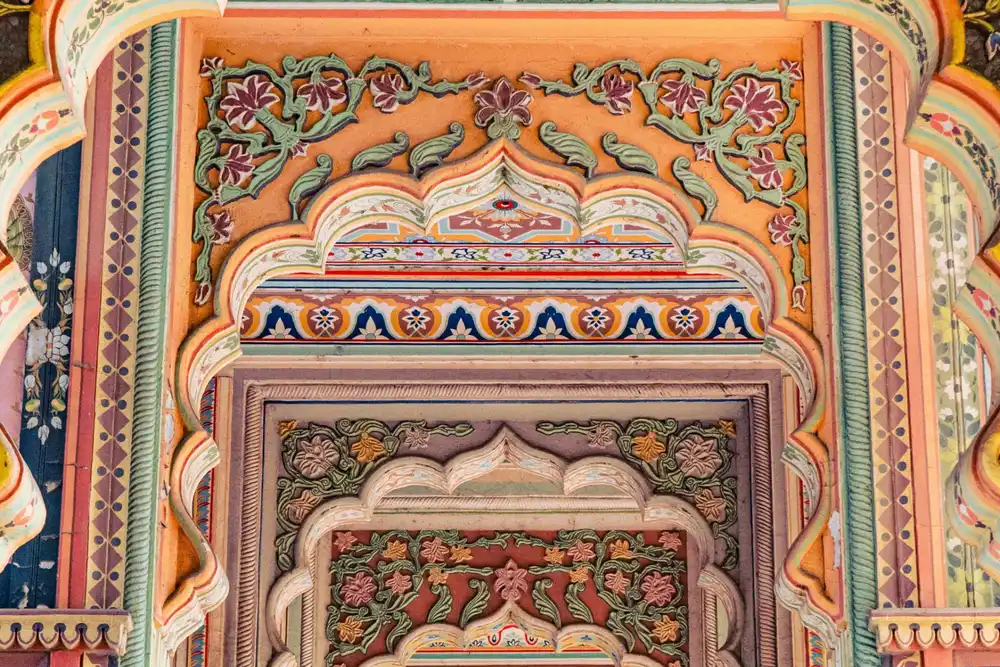
A close look at the painted arches of Patrika Gate.
Jaipur is one of the best cities in India for shopping, and a good place to try Rajasthani food. On the table, look for dal baati churma, a dish of lentils, baked wheat balls and a sweet crumbled wheat, and for laal maas, a spicy red meat curry that is a speciality of the region. Vegetarian travellers are well served, because much of Rajasthani cuisine is vegetarian. Lassi and masala chai are everywhere, and at certain times of year you will find ghewar, a honeycomb-shaped sweet.
The best things to buy are the local crafts: block-printed textiles, blue pottery, silver and gemstone jewellery, lac bangles, leather shoes and hand-knotted rugs. Ask your guide for help with shops. Our tours include no shopping stops unless you ask for them, so the choice is yours. Take your time, compare more than one shop, and be wary of anyone who says an offer ends today. Gemstones in particular need a trusted seller and a proper receipt.
October to March is the best time, with clear skies and pleasant days. December and January mornings can be cool and misty, and evenings need a jacket. April to June is very hot, and sightseeing then should be done early. July to September is monsoon, when the hills are green and crowds are lower, although heavy rain can interrupt plans.
Wear comfortable shoes, because every fort involves ramps and steps. Light cotton clothes that cover shoulders and knees are best for both heat and temples. Carry a hat, sunglasses, sunscreen and a reusable water bottle. See our best time to visit India guide for the wider picture.
For information about travel and tourism in Rajasthan, see the Incredible India website.
Jaipur is a city of stories, and a good guide makes the difference between seeing a palace and understanding it. A private guide explains the layout of Amber, the astronomy at Jantar Mantar and the craft behind the bazaars, and knows when to arrive so that you avoid the crowds. A private driver lets you move the plan: an early start for Amber, a long lunch, a change of order if the weather changes.
Our team has planned journeys from Agra since 2003, and Jaipur is the second stop on many of our tours. We will match the order to your dates and your pace. See our Jaipur and Pushkar tour, or read our Rajasthan itinerary guide to put Jaipur in the context of the wider region.
Two days for the main sights, three for a more comfortable pace and a workshop, and four if you want a day trip to Abhaneri or Samode.
Early morning, soon after it opens. It is cooler, quieter and easier to photograph than later in the day.
Yes. It is an 18th century astronomical observatory and a UNESCO World Heritage Site, and a guide brings its giant instruments to life.
Block-printed textiles, blue pottery, silver and gemstone jewellery, lac bangles and leather shoes. Ask your guide for help and take your time.
No. We recommend going up by jeep or on foot, which is quicker and kinder to the animals.
Abhaneri stepwell, Samode or Pushkar, depending on your interests. Abhaneri is on the road to Agra.
About 280 km from Delhi and about 240 km from Agra. Each drive takes roughly five to six hours with stops.
You can see the highlights in one long day, but it is rushed. Two days is much more comfortable.
Comfortable shoes and light cotton clothes that cover shoulders and knees. A hat and sunscreen help from March to October.
Related journeys: Jaipur & Pushkar Tour, 4 Days Jaipur Udaipur, Rajasthan Tours.

Mirza Shadab Beg began as a local tour guide in Agra and founded Travelage in 2003. He has worked as a local handling agent for BTI Sita, HRG Sita, Kuoni Travel Business, Century Travel and Gilpin Travel. Travelage is rated 4.9 on Tripadvisor from 466 reviews, is registered with the Ministry of Tourism NIDHI database (ID EUP000616), and has been recognised by Les Clefs d’Or India. Facts such as timings and rules are checked before each update, and may change.

Tell us your dates. We will plan the order, the guide and the workshop.