
A practical plan for two nights in Jaisalmer: the golden fort and carved havelis on day one, Kuldhara and a camel ride at the dunes on day two, and a night in a desert camp, with notes on Sam and Khuri.
Reviewed by Mirza Shadab Beg, Founder, Travelage India, Agra · Last updated 28 October 2026 · 11 min read
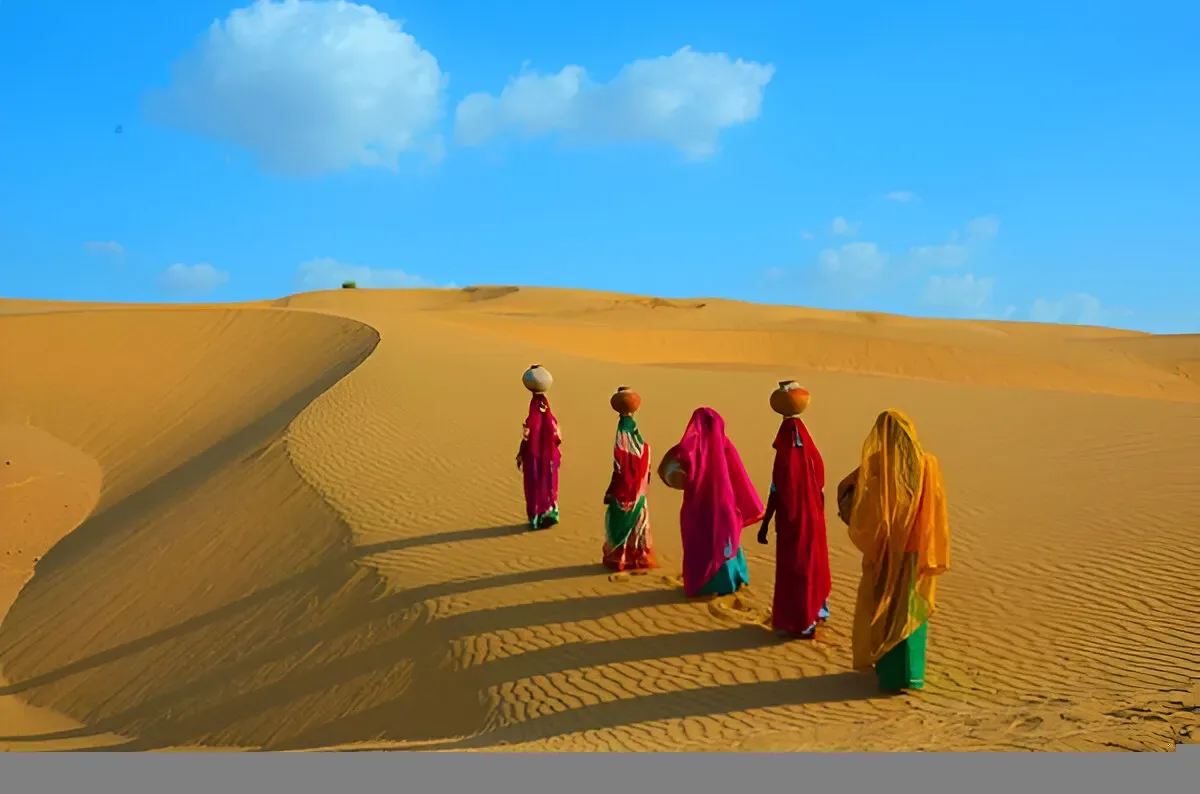
two nights is ideal for Jaisalmer. Spend day one on the fort, the havelis and Gadisar Lake. Spend day two on Kuldhara and a sunset camel ride, with a night in a desert camp. Sam dunes are bigger and busier, and Khuri dunes are quieter. Go between October and March.
Yes, two nights is the length we recommend for most travellers, and it is the version that works best with the long drive in and out. Jaisalmer sits in the far west of Rajasthan, close to the Thar Desert, and the road from the nearest big city is long enough that a single night feels like a rush. Two nights lets you spend one full day inside the town and one full day out in the sand, with a night under the desert sky in between.
Here is the shape of the plan we use. The first day is for the fort, the carved havelis and the lake. The second day starts with the ghost village of Kuldhara and the royal cenotaphs at Bada Bagh, then moves out to the dunes for a sunset camel ride and a night in a camp. The third morning is slow: watch the sun rise over the dunes, have breakfast, and start the drive onward. If you only have one night, keep the fort and the dunes and drop the extras. If you have three, add Lodurva and a quieter village or a lazy afternoon by the lake.
Most sights are close together, apart from the dunes. This table gives the working picture. Distances are approximate and travel times change with traffic and road works.
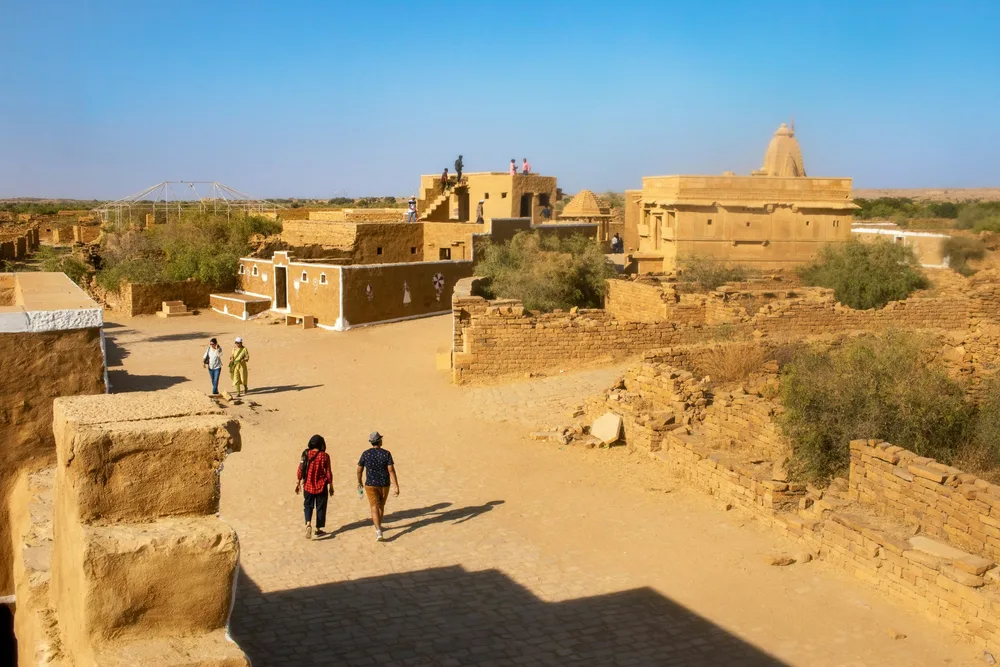
Restored mud houses and a small temple at Kuldhara, a short drive from Jaisalmer.
| Place | Distance from the old town | What to expect | Time to allow |
|---|---|---|---|
| Jaisalmer Fort (Sonar Qila) | In the town | A living fort with homes, shops, temples and a palace museum | 2 to 3 hours |
| Patwon ki Haveli and Nathmal ki Haveli | About 1 km | Carved sandstone mansions of 19th century merchants | 1 to 1.5 hours |
| Gadisar Lake | About 2 km | A historic rainwater reservoir ringed by small temples and chhatris | 45 minutes to an hour |
| Bada Bagh cenotaphs | About 6 km | Royal memorials that glow gold in late light | 45 minutes |
| Kuldhara | About 18 km | An abandoned village of the Paliwal community | 45 minutes to an hour |
| Sam dunes | About 40 km | Large dunes, busy camps, folk music | Late afternoon to next morning |
| Khuri dunes | About 45 km | Smaller dunes, a quieter village feel | Late afternoon to next morning |
Start with the fort in the morning, when the light on the honey-coloured sandstone is soft and the lanes are quiet. Jaisalmer Fort stands on Trikuta Hill and is called the Golden Fort for good reason. Unlike many Indian forts, it is not an empty monument. Families still live inside the walls, and the lanes are lined with small shops, cafes and temples. It is one of the six hill forts of Rajasthan listed together as a UNESCO World Heritage Site in 2013 (see the UNESCO World Heritage Centre for the official listing).
With a guide, a good order is: the main gate and the open square below the royal palace, the palace museum, the group of Jain temples carved in the 12th to 15th centuries, and then a slow walk along the ramparts to see the town spread out below. Wear shoes with grip, because the stone lanes are worn smooth.
In the late morning walk down to the havelis. Patwon ki Haveli is a cluster of mansions built by a family of wealthy merchants in the 19th century, with balconies and window screens carved so finely they look like lace. Nathmal ki Haveli is close by, and the story told locally is that two brothers, both craftsmen, each carved one half of it, so the two sides are slightly different. Treat that as a story rather than a fact, but do look for the differences. Salim Singh ki Haveli, with its arched upper storey, is worth a look from the street.
After lunch, rest. The afternoons are hot for much of the year. Then walk or drive to Gadisar Lake for the last hour of light. The lake was built as a rainwater reservoir in the 14th century, and the small temples and gateways on its edge are most photogenic at dusk. Dinner on a rooftop with a view of the lit fort is the classic way to end the day.
Leave the town in the morning for Kuldhara. This village was abandoned in the early 19th century by the Paliwal community, and its lanes of roofless stone houses still stand. Why the people left is debated. Local legends speak of a cruel official and of one night in which everyone departed, while historians point to water shortage and other pressures. Either way, the ruins are atmospheric and best visited before the heat builds.
Return towards town by way of Bada Bagh, a garden area with the cenotaphs (chhatris) of Jaisalmer’s Bhati rulers. The domed memorials are carved in the same sandstone as the fort and look their best in the low light of the evening or early morning, so you may prefer to stop here on the way back from the desert instead. Ask your guide to suit it to the light on the day.
After a late lunch and a short rest, drive out to the dunes in the middle of the afternoon. Arrive early enough to settle into the camp before the camel ride, which usually starts about an hour before sunset. The evening that follows is the point of the journey: tea on the dune, a ride into the golden light, dinner by a fire and folk music and dance, and then the quiet of a night sky that has very little light pollution. If you want to see our version of this day in full, look at the Jaisalmer desert safari tour.
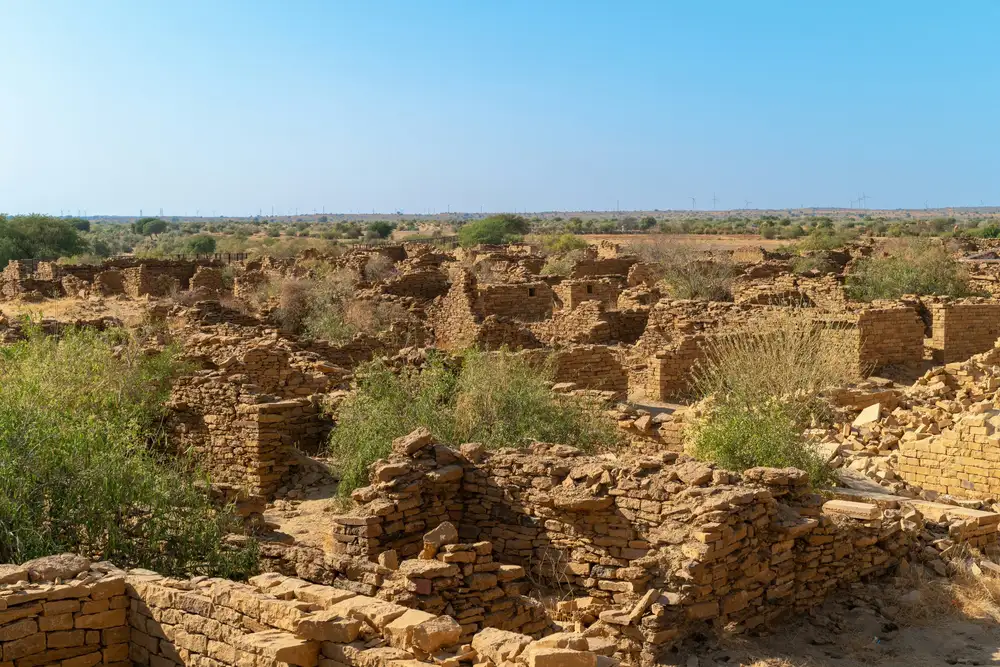
The ruined houses of Kuldhara stretch out across the desert floor.
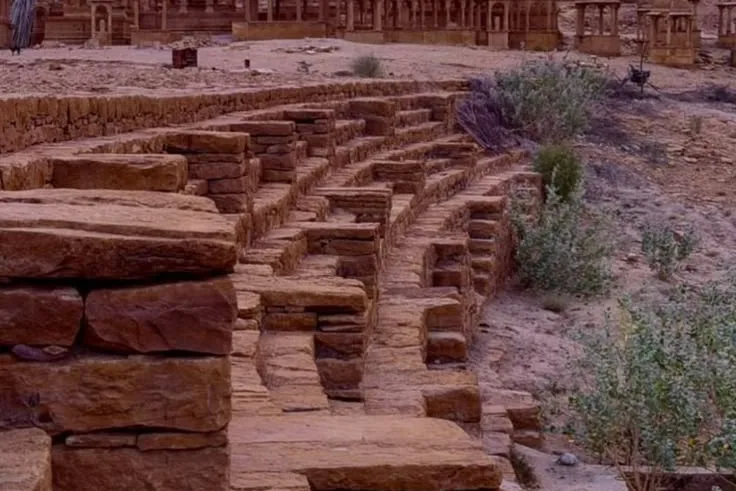
The royal cenotaphs of Bada Bagh catch the low evening light.
This is the most common question we are asked about Jaisalmer, and the honest answer is that both are good, but they feel different. Sam is the larger, better-known stretch of dunes, with more camps, more visitors and more activities. Khuri is smaller and quieter, and works well for travellers who would rather have a calm evening than a lively one.
| Sam | Khuri | |
|---|---|---|
| Distance from town | About 40 km | About 45 km |
| Size of dunes | Larger, more dramatic | Smaller, gentler |
| Atmosphere at sunset | Busier, more groups | Quieter, more private |
| Camps and facilities | Many camps, wide range | Fewer camps, mostly smaller |
| Activities | Camel rides, jeep rides, cultural shows | Camel rides, village walks, cultural shows |
| Best for | First-time visitors who want the classic scene | Travellers who value peace and space |
Our advice is to choose the camp first and the dunes second. A small, well-run camp at Khuri is a better night than a crowded one at Sam, and a good camp at Sam can still feel private if it sits at the edge of the dunes. Tell us whether you prefer lively or quiet, and we will match it.
Camps in the Jaisalmer area range from simple tents with shared facilities to comfortable lodges with attached bathrooms and proper beds. The difference is large, so it is worth knowing what you are booking. A good camp will give you a clean bed, hot water at a fixed time, a hot dinner cooked on site and a space for the evening programme away from the sleeping area.
Jaisalmer is about 285 km from Jodhpur, which is four and a half to five hours by road, and it is usually reached as part of a longer Rajasthan route. From Jaipur the distance is more than 550 km, so most itineraries break it at Jodhpur. The town has a small airport with limited flights and a railway station, but a private car is the simplest way to combine the fort, the dunes and the villages on the way. Our 6 Days Jaipur Jodhpur Jaisalmer tour follows this route.
| Season | Months | What it is like |
|---|---|---|
| Best | October to March | Warm days, cold nights, clear skies, ideal for the dunes |
| Festival | Usually February | The Desert Festival draws crowds and fills hotels, so book early; dates change each year |
| Hot | April to June | Very hot days, best for a short visit to the fort and an evening in the dunes |
| Monsoon | July to September | Little rain by Indian standards, a quieter and greener desert, but humid |
Keep in mind that areas close to the international border need permission for entry, and your guide will tell you where you can and cannot go. The usual tourist sights are not affected.
Jaisalmer is a place where a good local guide and an unhurried driver change the experience. In the fort, a guide explains the Jain temples, the families who still live inside and the carved details that most visitors walk past. At the dunes, a driver who knows the camps can take you to the one that matches your wishes, and can time the drive so that you arrive for the best light and not in the middle of a crowded afternoon.
A private car also means you can stop for a photograph at a roadside village or a wind farm on the dry plain, or take a detour to the Lodurva temples if you feel like it. You can read about our guides and how a trip is arranged on how it works.
Two nights is the length we recommend: one full day for the fort, havelis and lake, and one for Kuldhara and the dunes. With one night you must choose between the fort and the desert. With three you can add Lodurva and slower hours.
Sam is larger and busier, with many camps. Khuri is smaller and quieter. If you want a calm evening, choose a well-run camp at Khuri; if you want the classic big-dune view, choose Sam.
Kuldhara is a village of the Paliwal community that was abandoned in the early 19th century. The ruins of stone houses and lanes are atmospheric, and it makes an easy half-hour to an hour stop on the way to the dunes.
About 285 km, roughly four and a half to five hours by road. From Jaipur it is more than 550 km, so most routes include a night in Jodhpur.
Both. The palace is a museum, but families still live inside the walls, and there are shops, cafes and temples in the lanes. This is why a morning walk there feels so different from an empty fortress.
Warm layers for the night in winter, a scarf for dust and sun, sunglasses, a torch, sturdy shoes, a small power bank and a water bottle. In summer, add a hat and light, loose clothes.
No. It is a classic part of the evening, but a short ride is enough. You can also simply walk up a dune to watch the sun go down, and many guests prefer that.
October to March, when days are warm and nights are cold. The Desert Festival is usually held in February, and dates change each year.
Related journeys: Jaisalmer Desert Safari Tour, 6 Days Jaipur Jodhpur Jaisalmer, Rajasthan Tours.

Mirza Shadab Beg began as a local tour guide in Agra and founded Travelage in 2003. He has worked as a local handling agent for BTI Sita, HRG Sita, Kuoni Travel Business, Century Travel and Gilpin Travel. Travelage is rated 4.9 on Tripadvisor from 466 reviews, is registered with the Ministry of Tourism NIDHI database (ID EUP000616), and has been recognised by Les Clefs d’Or India. Facts such as timings and rules are checked before each update, and may change.

Tell us your dates. We will choose the camp, the dunes and the timing.